Monica from The Garden Faerie has a great article in the Ann Arbor newspaper about global warming. Definitely worth reading, no matter where you might garden!
http://www.annarbor.com/home-garden/global-warming-effects-on-gardening/index.php
Thursday, January 13, 2011


Tuesday, January 11, 2011
A Southern Garden with Extra Frosting

My little Pinus flexilis "Aurea"

Not the word I'm thinking about this weather!

There will be bright color in this urn soon!

Hinoki Cypress and "Teddy Bear" Magnolia

Parrotia "Vanessa" is the star of the snowy show!
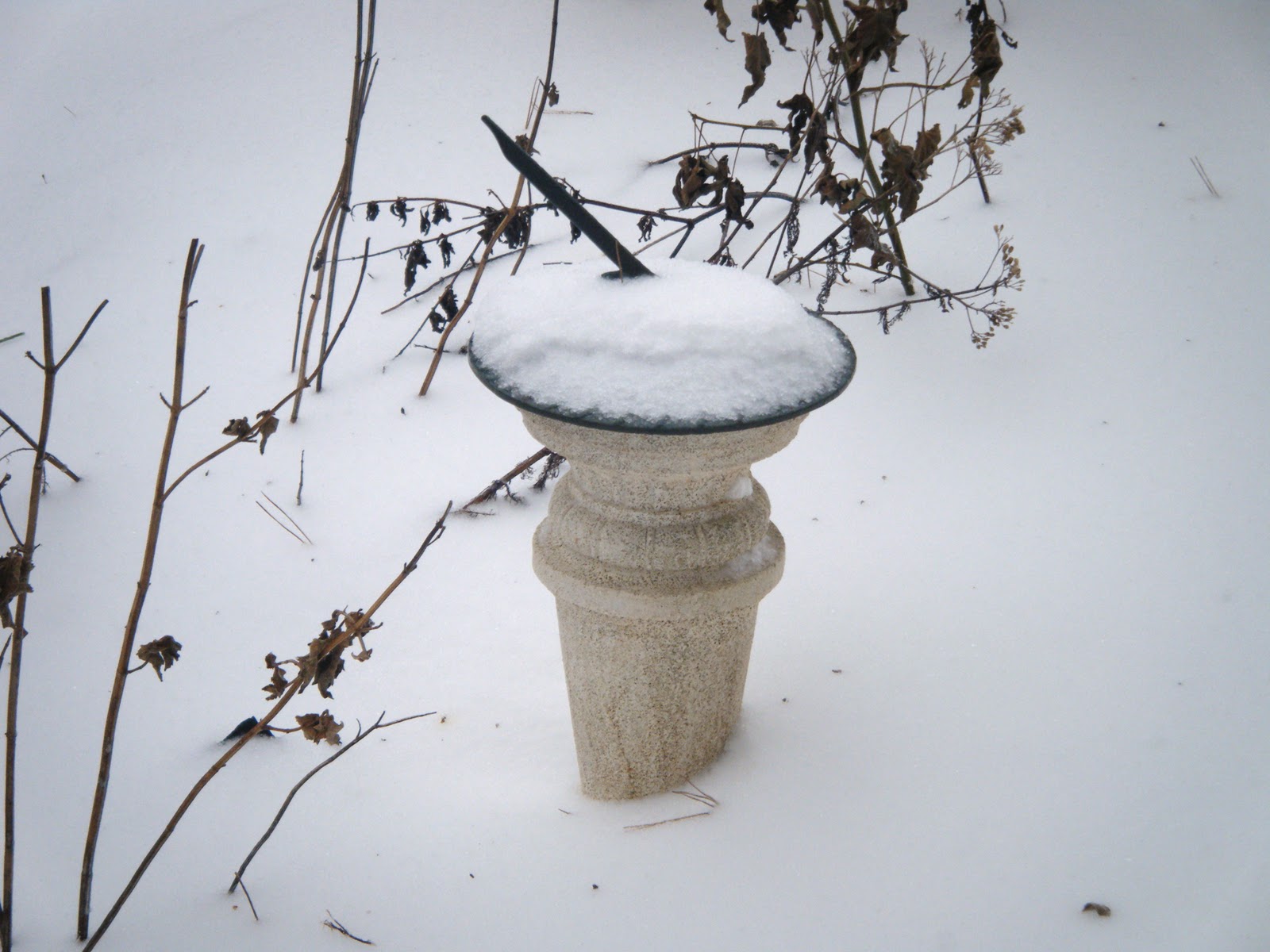
Anyone know what time it is?
Super Easy, Lentil Soup, Good and Good for You!

A photo above from the Associated Press yesterday
Can you tell that I'm a little crazy with this weather??? This is NOT why I moved south from New England! If the sun doesn't come out again today, I'm going to start putting those big airport runway lights in the Stepchild Garden.
In any case, here's one of the soups I made yesterday to stock the freezer. It's from an old Mayo Clinic-Williams Sonoma cookbook, so it's even good for you!
Lentil Soup
16 oz. dried lentils
7 cups water
4 c. vegetable broth
4 carrots, chopped
1 large onion, chopped
4 celery stalks, chopped
1 cup salsa
Fat Free Sour Cream
Pick over the lentils, rinse under cold water, and drain.
In a large pot, bring the lentils, water, broth, veggies and salsa to a boil. Reduce to a simmer, cover, and continue to cook for 45 minutes, or until the lentils are tender. If the soup is too thick, add a little more water.
Garnish with the Sour Cream, if you want.
A Note About the Salsa: The cookbook suggests making your own fresh salsa, which you certainly can do. Since this is really not the season for great tomatoes, I rely upon Herdez Salsa Casera, which my friend Rafael uses often as a cooking base for soups and sauces. He is an incredible cook, and is originally from Merida (the Yucatan peninsula of Mexico). The Herdez products are actually from Stockton, California, and this salsa is usually in small cans in the Hispanic foods section of the supermarket. It has a depth of flavor without being "burn your face off hot," like many commercial salsas.
Sunday, January 9, 2011
I'm Afraid Chuck Might Move Out of the Neighborhood

I have attended the symposium for the past few years, and always come away with some great ideas for both the stepchild garden and the garden at The Big House. Great new plants, cool combinations that I hadn't considered before, etc.,etc. All good things.
Here's the problem........
Dan Benarcik from Chanticleer is the first speaker that morning. Anyone who follows this blog knows that I'm a bit of a Dan Benarcik groupie, and have absolutely no problem telling people that my goal is to have a garden that looks like Chanticleer.
The last time I became obsessed with something from Chanticleer was the Adirondack chairs that Chuck foolishly agreed to make for me as a birthday present. (That story is in a post here from late July of last year). By the time they were finally finished, Chuck almost threw them across the street to my house, and I had to do the painting!
I think I need to start reminding Chuck that his chairs are one of my favorite things in the garden, and remind him that they really weren't all that difficult to make..........if Dan Benarcik has any cool new things in his presentation for me to obsess about (and he will), I'm screwed.
Friday, January 7, 2011
The Calendar, continued
Two things I left out of the last post:
1. I keep this document on my computer as a regular Excel document. By doing that, I can keep editing and saving, I can cut and paste for things that happen every month, can remove items that die or get "shovel pruned," and add things that are added into the garden. I'd love to tell you it's a fancy process, but it's not.
2. The other thing we do during the first week of each month is fertilize everything in the greenhouse (except those few exceptions which go dormant for the winter or have more specific needs) with a weak liquid fertilizer (something suitable for houseplants). Organic liquid (fish based) fertilizers are great for this, but will often leave a "funky" odor for a few days.
Thursday, January 6, 2011
This Week in the Garden
One of the practices I've developed over the years is the continual use of a "garden calendar" that I've developed over time, which includes the plants in the gardens at the Big House, as well as those in the Stepchild Garden. Whenever I purchase or install a new plant, I take the time to Google its recommended maintenance schedule for this particular zone, and add those notes into the schedule. This information is merged with thoughts from local gardeners, experts about particular plant species, etc. I've found that it's the only way I'm able to keep up with some things that need doing, and over the past few years, it has made a marked difference in the success I've had with particular plants.
As a result, I'm going to start posting "This Week in the Garden" on a weekly basis. If you're in this same zone (7B to 8, depending upon who you ask), feel free to take any of these things for your own calendar. If not, take what's helpful, and use it to help yourself develop your own schedule. The other added bonus is that this list prompts me to visit some out of the way spots in the garden that I don't always pay enough attention to, catching bugs and such before they become a problem.
January Pruning: Abelia, Bottlebrush Buckeye, Vitex, Clethra, Confederate Rose, arborescens Hydrangeas, Hypericum, Oakleaf Hydrangeas, Gardenia, Osmanthus, Pyracantha*, Agarista, Arborvitae, Boxwoods, Evergreen Hollies, Crape Myrtles, Figs can be pruned hard in January
Fertilize: Pansies every two weeks (temps must be below 60 degrees F) with pansy fertilizer, Liquid 10-10-10 on bulbs once two inches of foliage is visible
Miscellaneous: Spray Dormant Oil on Branches of Fruit Trees to Suffocate Dormant Insects
Now, before you get all worked up about this (as only gardeners can), please remember that this is what I do, and it may not be applicable to your particular garden. A couple of notes, as well....if the pyracantha looks really good and is still covered with berries, I won't prune it until February.Similarly, most of these things listed are fine getting pruned in January or February; with the number of plants I need to prune by hand, and the number of daylight hours in the winter, I need to start now or I'd never get done!
The Greenhouse, Continued
I got several comments via this blog and email about the post I did about the greenhouse, so I thought I would add a couple of other things.
Temperature is a big deal. We have three thermostats in the greenhouse, which I think is fairly common. One controls the gas blower heating system (which looks like something you'd see in a warehouse or an old gas station!); the second opens the louvers to allow hot air out when it gets too hot; the third takes that process (cooling) one step further, with a huge exhaust fan. Everyone thinks about needing to heat the greenhouse in winter, but very few people consider how hot these buildings can get, particularly in warmer months. We maintain a temperature of around 60 degrees in winter, and tweak that occasionally. As spring approaches, we gardually open all of the doors and allow the plants to start hardening off in what basically becomes a giant cold frame.
In a similar vein, we do a lot of moving of pots to keep them in their optimal light conditions. Not as big a deal in winter, but in summer, many things will simply fry if they're not shaded. Before summer comes, we'll be installing some shade cloth panels in various parts of the ceiling to control light more.
The television show is called "Growing a Greener World," and is produced by Blue Ridge Public Television, out of Roanoke, VA. It's on lots of PBS stations, but (of course) not in Atlanta, so once the episode is edited and ready, it will be available on their website. I'm guessing that is months away.
Subscribe to:
Posts (Atom)